
How Property Tax Bills are Calculated
The Assessor determines the properties market value. For real estate, market value is set as of January 1 of odd-numbered years. For personal property, market value is set each January 1. Vehicle market value is based on the October issue of the NADA also known as JDPower. Taxpayers can refer to RsMo 137.115 for Market Value of personal property.
After the market value is determined, the Assessor calculates the assessed value by applying the percentage for the property’s classification. For example, Residential property is assessed at 19% of its market value (market value × 0.19). Agricultural property is assessed at 12%, Commercial at 32%, and Vehicles at 33%. Once the assessed value is calculated, the tax levies are applied to determine the tax bill.
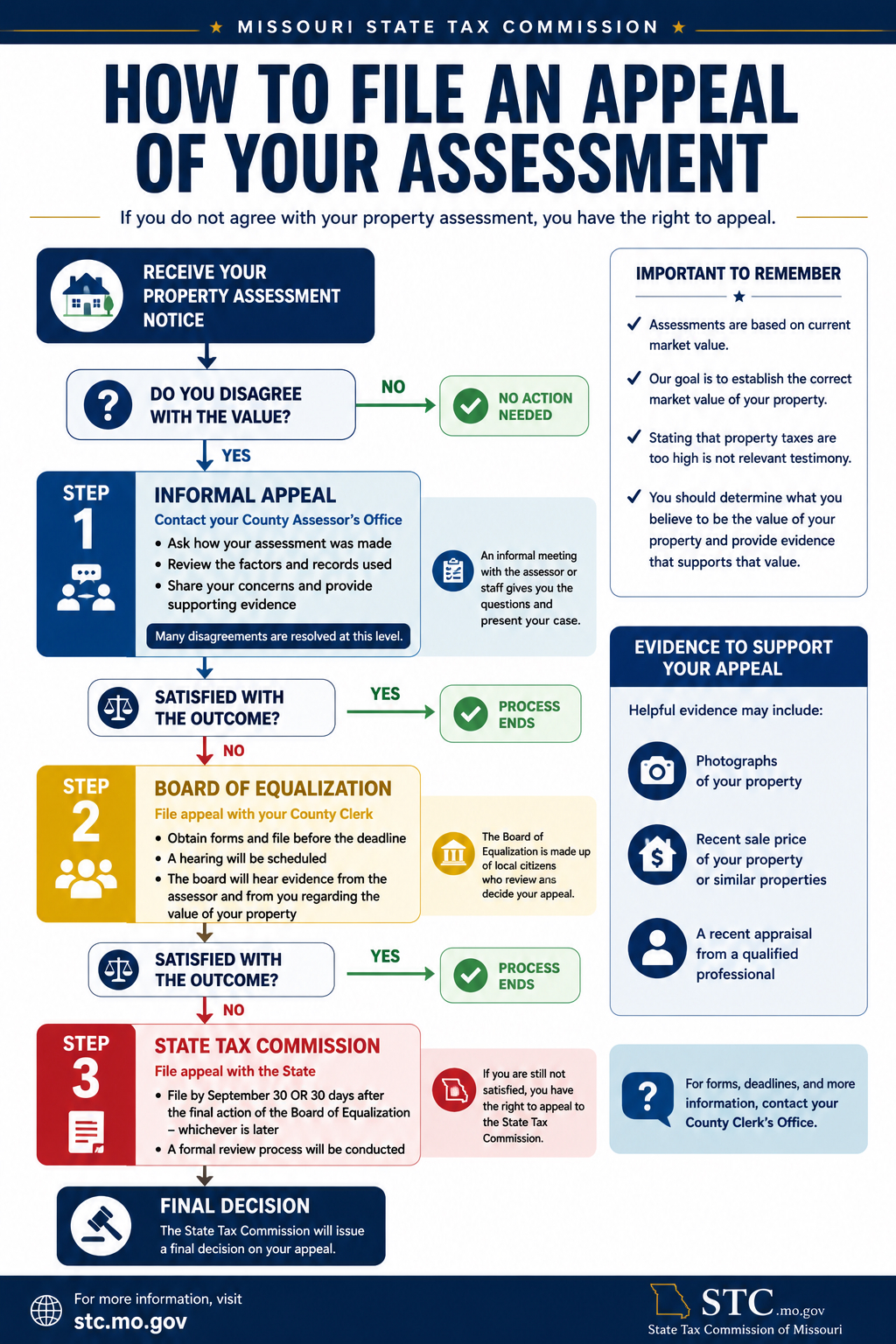
If your informal meeting with the Assessor is unsatisfactory and you wish to move on to a formalized meeting with the Board of Equalization, ensure to call and make an appointment.
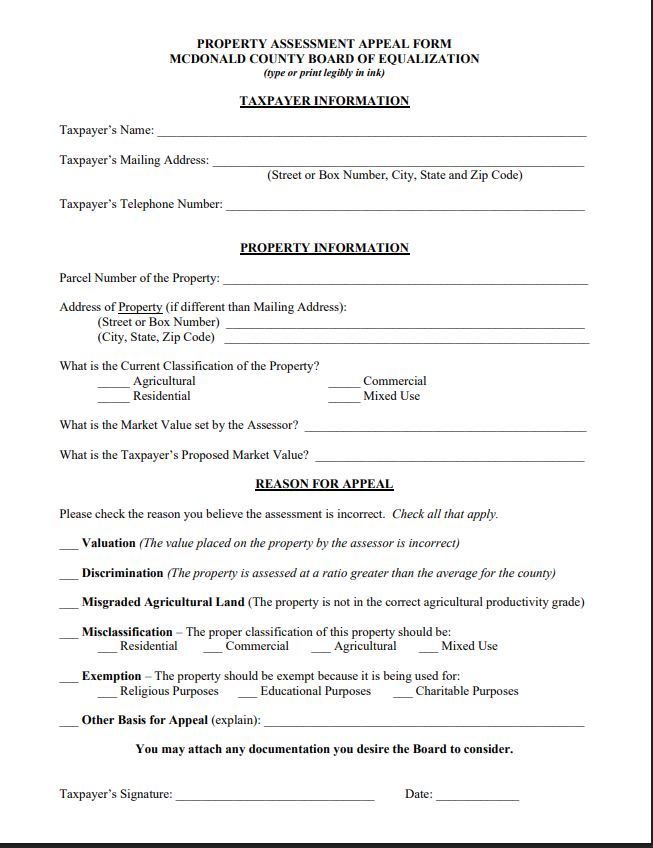
Walk ins are not allowed. To file an appeal please submit the form hyperlinked below.
https://acrobat.adobe.com/id/urn:aaid:sc:US:3956d151-9d2c-453b-90b5-8d6ba1d1c5ca
Understanding assessed value and your tax bill
Assessed valuation (AV) is the value used to calculate property taxes. The assessor determines a property’s value for assessment purposes, and local political subdivisions apply levy rates to the AV to fund public services.
• Why your assessed value might change: New construction, changes in property condition, updated property record details, neighborhood market activity, or correction of an error.
• Why it matters: Your tax bill is based on your assessed value and the levy rates set by local taxing districts (before credits and other adjustments).
Where Do Your Tax Dollars Go?
Your tax bill is made up of several political subdivisions (such as the school district, city, fire district, and others). Each subdivision sets a tax levy for your area.
To see how the total is calculated, review the Example Tax Bill below. Your assessed value is multiplied by each levy listed for your area. Those amounts are added together to equal your total tax. The County Collector collects payments and then distributes the money to the County Treasury for it to be distributed back to each political subdivision. In other words, the county serves as a clearinghouse—collecting tax payments and sending each entity its share.
Disclaimer fees are collected as allowed by State Law for the Collector’s Tax Maintenance fund and Assessment funds: RsMo 52.260 & 82.650 & 54.320 & 52.250.
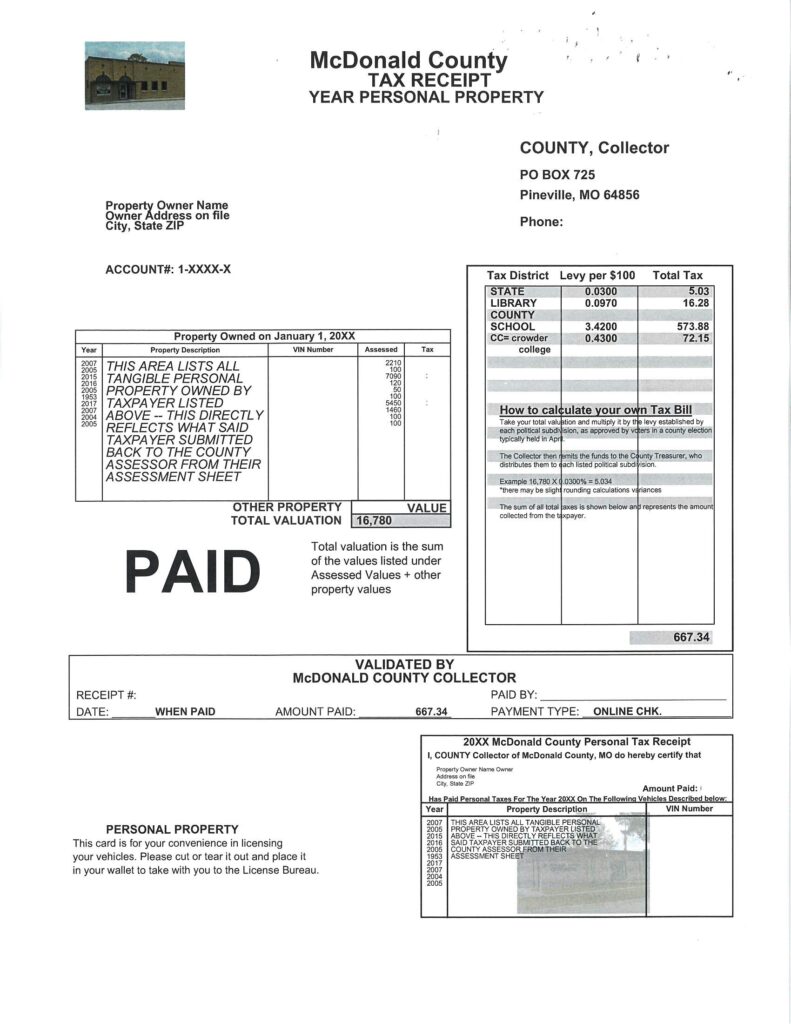
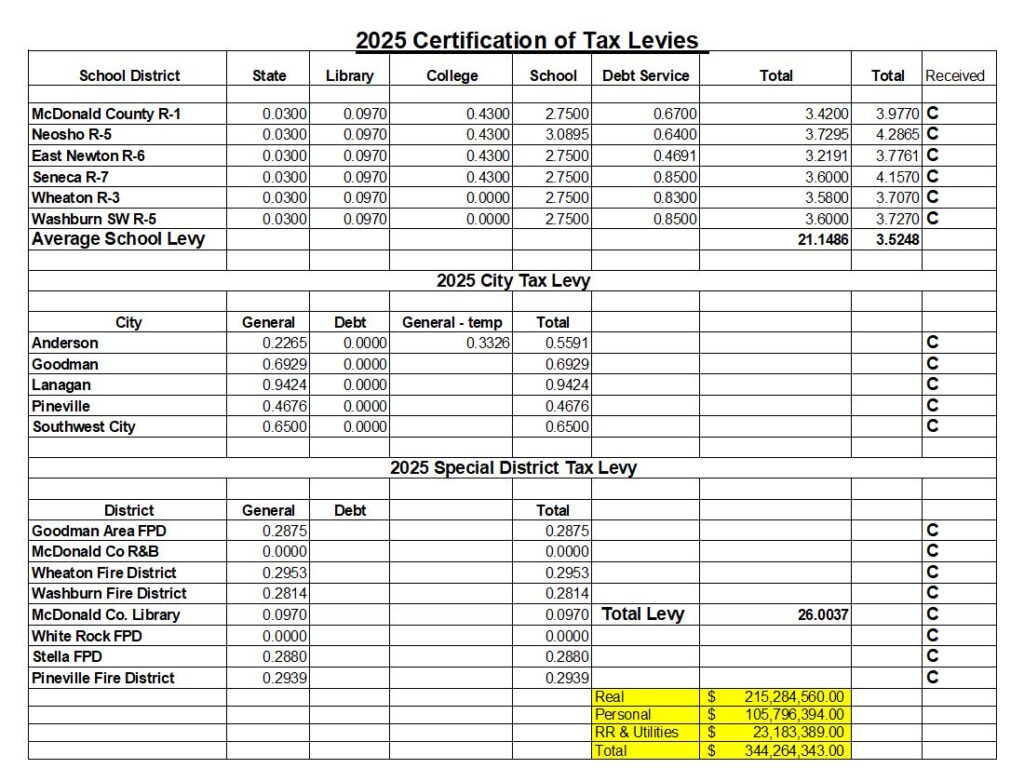
Image above depicts the tax rates set by Political Subdivisions within McDonald County.
What are “political subdivisions”?
Political subdivisions are local taxing districts (for example, counties, cities, fire protection districts, ambulance districts, road districts, and others). These districts use assessed values—along with their levy rates—to calculate revenue for local services. After assessed values are finalized, counties complete required reporting and levy-related compliance steps for these districts to the State Auditor’s Office and Collector for tax bill collections.
Tax cycle basics (why dates matter)
• September 1: The annual county assessment cycle typically begins.
• January 1: Common “as of” date for what property is on the rolls for that year.
• March 1: Common due date for personal property declaration forms
• July 1: Assessed values are typically provided by the Assessor to the County Clerk for required compliance reporting and levy-related steps back to the State Auditor’s & Tax Commission offices.
Who’s involved (and what each office does)
• County Assessor: The Assessor plays a vital role in tax assessment of county property for all county residents and businesses alike, ensuring values are accurately determined for fair taxation as allowed by law, RsMo 137.115. County Assessor maintains property records and determines assessed values for assessment purposes.
• County Board of Equalization (BOE): Holds hearings and makes decisions on assessment appeals at the county level should evidence change the values set by the County Assessor.
• County Clerk: Supports BOE administration and completes required reporting and levy-related steps after values are finalized, the Clerk does not maintain property records nor sets the values.
• County Commission: Has certain legal responsibilities related to assessment/equalization steps, as provided by Missouri law.
• Missouri State Tax Commission (STC): State-level appeal option if you disagree with the BOE decision.
• State Auditor’s Office: Receives certain required reports and supports compliance processes for political subdivisions.
How to prepare:
• Review your property record: Verify facts (size, condition, improvements, outbuildings, etc.).
• Write down your concern: Is it a record error, or do you disagree with the value based on the
market?
• Gather evidence: Comparable sales, appraisal, photos, repair estimates, surveys, or documents that
correct errors.
• Contact the Assessor early: Many issues can be resolved informally through review and corrections.
• If needed, file your BOE appeal on time: Keep copies of everything you submit.
Why this process exists
The assessment and appeal process exists to promote accuracy, uniformity, and fairness. It gives taxpayers a clear way to ask questions, correct errors, and present evidence when they believe an assessment is incorrect.
What the BOE meeting looks like:
BOE hearings are formal, scheduled meetings. A chair runs the meeting, members confirm a quorum, and the BOE follows a consistent process so each taxpayer has a fair opportunity to present information.
• Appointment-based: Hearings are scheduled in time slots (often about 20 minutes).
• Order and transparency: The BOE meets publicly, confirms a quorum, and follows a set agenda.
• Your turn: You explain what you’re requesting and provide your evidence.
• Questions: BOE members may ask clarifying questions. The Assessor’s office may provide information for the record.
• Decision by motion and vote: A motion is made, seconded, and voted on so the decision is clear and recorded.
Written outcome: The BOE issues its decision, including information about next steps if you disagree.
Tip: Be organized and brief. Focus on facts and documents that support the value you are requesting. County staff can help with forms and procedure, but cannot provide legal advice.
Questions? Contact your County Assessor about your property record and value, and your County Clerk about BOE filing procedures, hearing schedules, and deadlines.
2026 BOE DATES July 20th between the hours of 8:00AM – 2:00PM
Walk Ins are NOT PERMITTED — Must make an appointment by calling the County Clerk and requesting a formal appeal form.